
A Primer on Stablecoin Clearing
The Better Money Company's Stablecoin Clearinghouse

Every week, I study a number of fascinating companies trying to solve unique obstacles using stablecoins.
This week I want to take you on a journey inside the rabbit hole of stablecoin clearing. One of the many many obstacles we need to solve to be able to onboard Fortune 500 companies and have them integrate stablecoins in their inner plumbing.
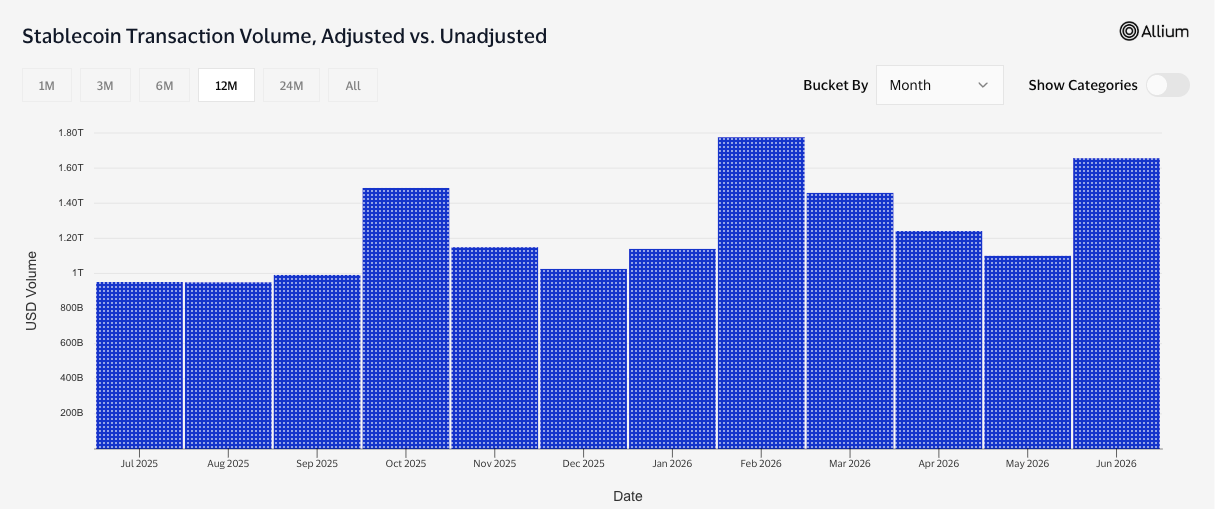
Stablecoins in the last 12 months moved $14T+ (adjusted volume) across chains. But have you tried swapping $1M from one stablecoin to another?
No matter what platform, middleparty, or OTC desk you use, $1 million USD in stablecoin A never equals $1 million USD in stablecoin B. The transaction cost can range from a few bps to a few hundred.
Imagine valuing Wells Fargo dollar 2% lower than Bank of America dollars on every transaction. That would be an inefficient system, unacceptable in modern banking. And yet, such is the case with stablecoins today.
Funnily enough, local banks solved this problem 200 years ago.
In the antebellum US, private banks had the ability to print their own dollars. With no such entity as the Federal Reserve in existence, people would rely on these private bank notes for personal and commercial transactions. While this era in economic history is tagged as the era of notorious wildcat banks, it was a great example of free banking in effect.
So what kept a system with a dozen different private bank notes functioning?
The answer is a clearinghouse.
A clearinghouse is an entity that allows for different currencies to be exchanged at par value. Meaning, if bank A had amassed a collection of Bank B, C, and D notes, and needed to reconcile the balance sheet, they’d simply visit the clearinghouse, deposit their mixture of dollars, and after netting, collect gold/silver specie on the surplus.
One of the earliest examples of such a clearing house was the Suffolk Bank in Boston that facilitated the free banking regime of New England in the mid-nineteenth century.
With stablecoins, the need for a clearinghouse is more dire than ever. While there are only two dominating stablecoins in the system, with the passage of the GENIUS Act, we’ll be seeing more compliant stablecoins pop up everywhere.
What about existing solutions?
Today, moving from one stablecoin into another means using infrastructure built for trading, not for payments. There are three options, and none of them work at size.
A dex. You sell coin A into a pool and buy coin B at whatever price the pool quotes. The deepest USDC/USDT pool on-chain holds about $160 million, and even that is 71% skewed toward USDT, so the real two-sided depth is thinner. That is the deep end of the entire market.
None of the compliant stablecoins holds meaningful liquidity against another non-USDC coin. Each is anchored only to USDC or USDT, so converting PYUSD into RLUSD, or USDG into USD1, takes two hops through a hub and pays slippage twice.
Below a million dollars everything seems fine. Anything meaningfully above would destabilize the pools.An OTC desk. Pricing is better, roughly 2 to 8 basis points on a multi-million-dollar USDC/USDT ticket, but you take on a relationship to maintain, a minimum ticket, and counterparty risk you now manage yourself.
Desks like Cumberland, FalconX, and B2C2 are general-purpose market makers, positioned across a dozen moving markets at any given moment. Relying on them exposes you to unnecessary market exposure from second order effects.Network-based clearing. M0 and Brale let the coins they issue swap among themselves at par. Genuinely useful, but walled. No issuer has a reason to do the slow, bilateral integration work that would make its coin fungible with a rival’s, so no one does. Circle’s CCTP and Paxos’s mint-and-redeem are at par, but only inside a single issuer. Not one of these spans Circle and Paxos and Ripple and Tether.
This is where The Better Money Company comes in, the first neutral stablecoin clearinghouse of its kind.
How it actually works
Better Money runs no order book and holds no onchain liquidity pools. When a client needs to swap between Coin A and Coin B, Better Money internally connects to the issuer’s mint-and-redeem system to conduct the swap.
Because every GENIUS-compliant coin is backed one-to-one by reserves, the swap happens at par by construction. There is no market to move and no slippage to pay, because there is no market in the loop at all.
Their primary focus is on netting. Business payments tolerate a settlement window, anything from an hour to end-of-day, and inside that window, Better Money batches the day’s flows so the money that actually has to move is a fraction of the total volume.
This is the same multilateral netting that ACH and CHIPS have run for decades.
With that primitive in place, you can solve roughly three problem categories.
Problem A: the public orderbook liquidity trap
Say you run a neobank (or a regular company) and you have issued your own stablecoin. Now a customer wants to swap out of your coin for USDC.
Today that means running a liquidity campaign: standing up a trading desk, seeding pools across a dozen venues, and hoping the depth holds when someone moves size.
The cost of moving a low-liquidity coin is at 10 to 20 basis points of slippage, and it gets hard above $100,000.
Better Money replaces this process with a membership.
You join as an issuer, it connects to your mint-and-redeem facility, and from that moment anyone holding your coin can swap, send, or bridge it at 1:1 with a known fee and a known settlement time.
You can finally put a fixed price next to the Send button, without variable external dependencies.
Problem B: agentic payments at speed
Sam Broner, Better Money’s CEO wrote about how agents will behave like locals in a bazaar, not like tourists.
They’ll transact with preexisting relations on pre-negotiated terms: transacting constantly, in small increments, with no human in the loop.
Gartner expects, by 2028, 90% of B2B buying to run through AI agents, pushing more than $15 trillion of business spend through agent exchanges.
You and I pay an agent out of a fixed budget. But a business will see it as a growth avenue. The higher the ROI, the bigger the budget.
And an agent transacting across a world of fifty branded stablecoins will face the same fungibility issue as everyone else, except that it cannot call an OTC desk.
The solution is a clearinghouse. Better Money lets the agent pay in whatever it holds (as long as GENIUS-compliant), and the merchant receives exactly what it asked for. An invoice for $789.87 settles as exactly $789.87.
Problem C: the custom stablecoin dilemma
This isn’t a today problem. But once the GENIUS Act is in effect, companies will be incentivized to launch custom stablecoins: be it for the yield and treasury management, for control over compliance, or for the brand.
But if today’s complexities were to remain as is, a low-liquidity branded stablecoin would be no different from a gift card. Practically useless outside of the brand’s ecosystem.
But a clearinghouse, regardless of liquidity economics, provides every new branded stablecoin with an instant, guaranteed exit into any other stablecoin. Any user will be able to use any stablecoin issued by any brand at any venue.
The roster of companies that have already launched or announced one is ever-growing. From SoFi and Société Générale to Western Union and Cloudflare, etc. Stripe’s Bridge, which lets any business mint a compliant coin in a few lines of code, expects “dozens, if not hundreds” more.
The neutrality bet
Companies that offer stablecoin clearing services to any extent suffer from a self-imposed handicap. They can’t offer to facilitate the clearing of competing stablecoin pairs.
That’s why Better Money decided to remain neutral.
Sam said in a podcast, “It’s really important to us that we’re neutral infrastructure,” he says. “That’s part of why we don’t issue our own stablecoin.” Everything else is downstream of that one choice.
Look at their partner ecosystem.
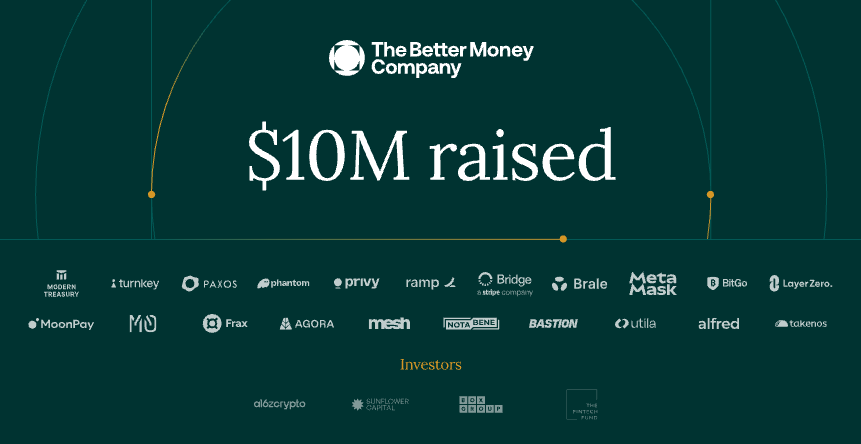
Several of those are direct competitors who would never seed liquidity into each other’s pools. But they will do business with a neutral third party.
Every durable payments network has some version of this neutrality. The first clearinghouses were neutral taverns where couriers from competing banks met to settle. SWIFT and ACH followed the same logic.
Dee Hock built Visa as a member-owned cooperative for exactly this reason: no single bank could own the network and still convince the others to join, so the network had to belong to all of them and favor none.
Threat Analysis
Vertical Capture
The primary threat to Better Money is vertical capture. Payment giants with massive distribution networks are already trying to build their own systems:
Circle is building a complete, closed stack. It controls the USDC stablecoin, the CCTP cross-chain layer, and its own Payments Network. It is also launching Arc, an institutional blockchain at a $3 billion FDV.
Stripe owns the minting platform Bridge and recently launched Tempo, a blockchain valued at $5 billion. Stripe built this network alongside major design partners like Visa, Mastercard, and Deutsche Bank.
In theory, any of these powerful players could build their own payment interchange. Since Circle alone controls 90% of the GENIUS-compliant stablecoin market, they, for all intents and purposes, set the terms.
But with more competitors entering the market over the coming years, Circle’s unilateral grasp will come down meaningfully.
TradFi Competitors
While it’s not a direct market share battle, it does affect Better Money’s future plans peripherally.
JPMorgan, Citi, Bank of America, and Wells Fargo, with a dozen peers, are building a shared tokenized-deposit network through The Clearing House.
Citi’s Jane Fraser says there is “an overfocus on stablecoins,” and that tokenized deposits, an onchain version of bank deposits, will be the cornerstone.
Though a tokenized deposit is a different instrument, Better Money can fold tokenized deposits into the same clearinghouse. If they do move in that direction, it’d be an interesting TradFi vs Fintech battle.
Regulatory Uncertainty
The third threat is the regulator.
The GENIUS Act tells regulators to consider whether to mandate an interoperability standard, and the OCC’s rulemaking to implement the Act, asks that question.
If a standard is ever mandated, neutral clearing could turn into a public utility, causing economics to tighten further and rely on high volume over spread. But it’s quite a nuanced scenario to explore, if it ever comes to it.
What the future holds
Every credible forecaster now agrees on direction and argues only about size. Standard Chartered and the US Treasury’s own borrowing advisory committee both put stablecoin supply at $2 trillion by 2028, around seven times today’s $300 billion.
Citi’s 2030 base case is $1.9 trillion and its bull case $4 trillion. McKinsey models $2 to $4 trillion, Bernstein $4 trillion. Even JPMorgan, the house bear, calls $500 to $600 billion, still close to a doubling.
There is no serious scenario with fewer coins and less cross-issuer flow a few years out.
Cross-border B2B payments are a $56 trillion market by 2030 on FXC Intelligence’s numbers, and they still ride correspondent rails that cost north of 6% on small tickets and leave trillions parked in pre-funded accounts. Stablecoins have barely touched it.
Of the roughly $35 trillion in stablecoin volume last year, McKinsey and Artemis find only about $390 billion was real end-user payments, $226 billion of it B2B, up 733% in a single year. Juniper projects cross-border B2B stablecoin payments to climb from $13 billion in 2026 to $5 trillion by 2035, by which point it expects them to be 85% of all stablecoin value.
That is the curve Better Money is positioned across, and every dollar of it crosses issuers.
Sam thinks the same logic eventually brings in the banks. Their tokenized deposits have the same liquidity problem, and the same clearinghouse can solve it. The endgame he describes is the one where you stop thinking about any of this. You see a dollar balance, you trust it does what a dollar should, and the machinery that makes a hundred coins behave as one money fades into the background, the way no one thinks about the Suffolk Bank when they tap a card.