
Polygon's Stablecoin Gambit
Building the first vertically integrated Open Money Stack

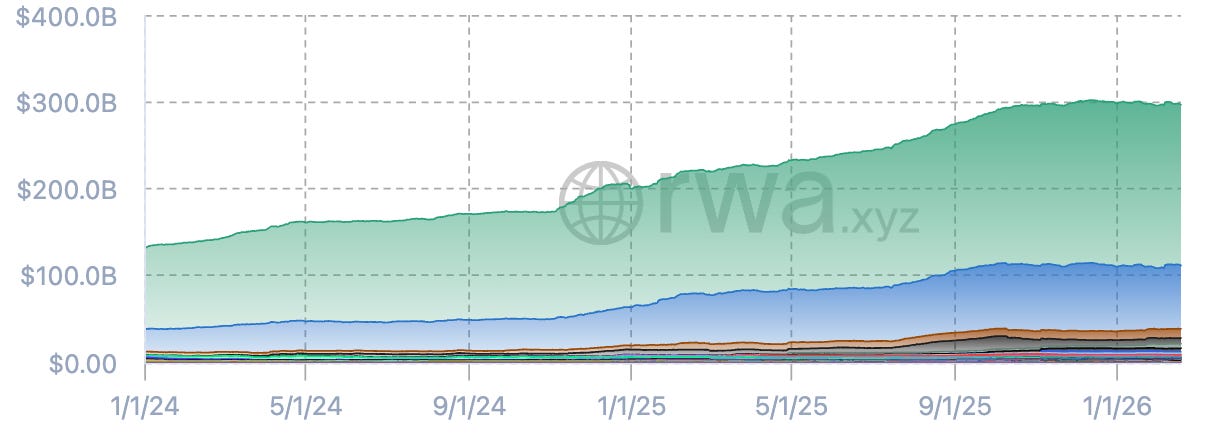
Stablecoin market cap has more than doubled in the last two years. But we’re still stuck inside a broken system.
Despite being the fastest payment technology on Earth, how come no one’s using it outside of crypto?
I ask myself this question often. And unfortunately, we all know the answer.
If you don’t, here’s a good way to think about it:
Imagine going to a business meeting where everyone speaks in a different language, and they all bring their own interpreter. And the interpreters don’t know all the languages, so sometimes they will have to use another interpreter to understand what someone is saying, then translate it into your language.
This is what stablecoin payments look like today. To receive/spend $100 in stablecoins, you need three to five different platforms. And those platforms don’t talk to each other.
You can use this system to move a few thousand to a few million dollars, but a company with a multi-billion-dollar treasury or AUM won’t touch it. It’s unreliable and unpredictable.
There have been multiple attempts at solving this issue with little success.
But recently, Polygon jumped into the scene with their Open Money Stack vision. It’s a new stablecoin payments framework focused on scalability. This is by far the best stablecoin infra vision I have seen from a company, so I decided to write a deep dive on it.
What is Polygon’s Goal with the Open Money Stack?
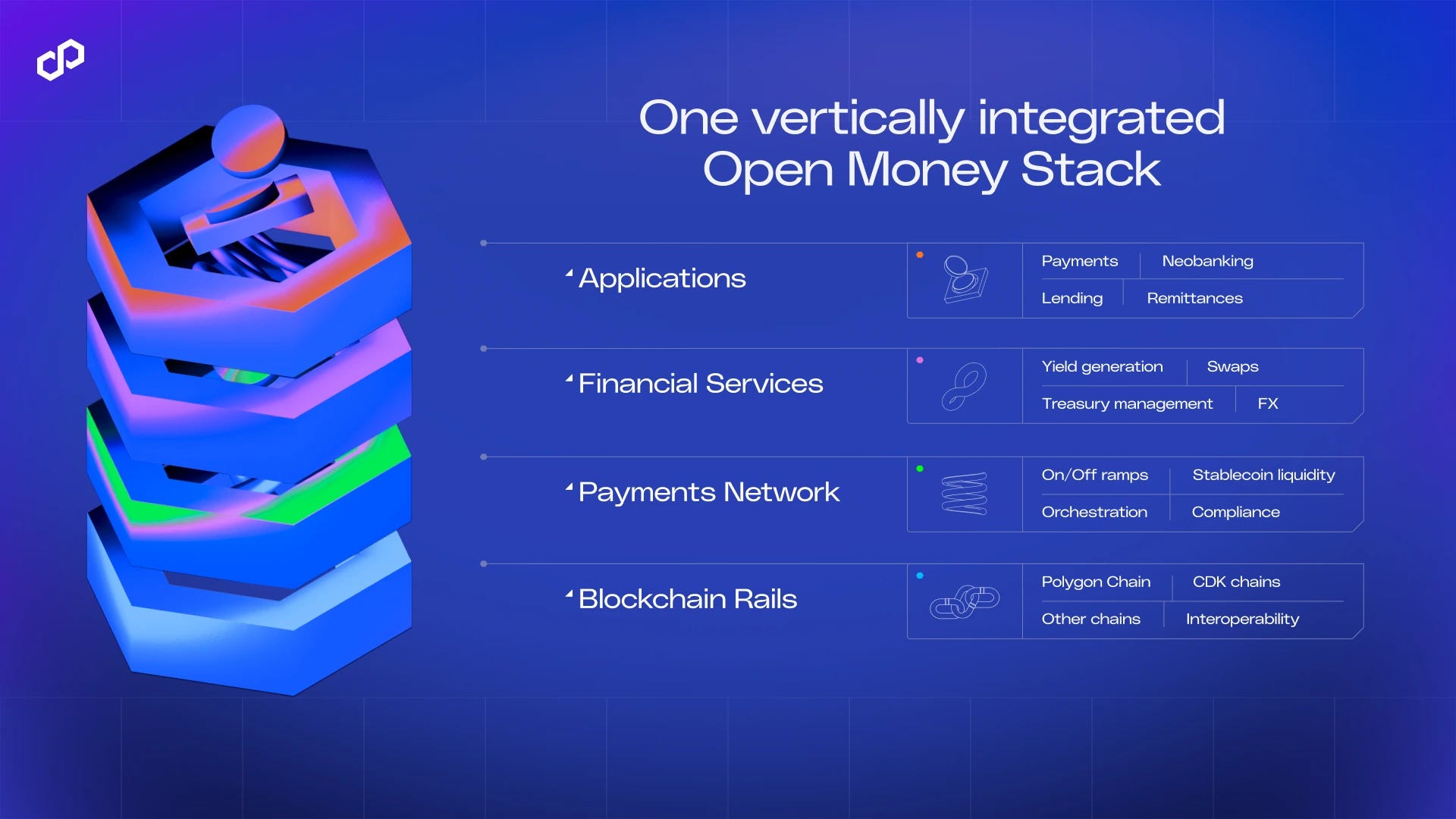
Open Money Stack (OMS) is best explained as an attempt to make stablecoin payments feel less like “using blockchains” and more like plugging into a conventional fintech payments stack.
The best stablecoin payment platforms today, like Stripe, BVNK, Fireblock, Circle, etc have mastered one particular layer of the stack, not the entire end-to-end process. Depending on what platform you use, you’ll need several of these: API for payouts, a separate wallet/custody layer, separate on/off-ramps, separate reconciliation tooling, and then a lot of integration glue to make it behave like an enterprise-grade system.
OMS’ vision is to simplify the process and build a comprehensive solution that makes the entire stablecoin payment flow seamless. It’s a vertically integrated stack that bundles the full journey—wallet infrastructure, on/off ramps, orchestration, and settlement—so a company can run stablecoin-based money movement end-to-end without having to build a custom payments platform.
It’s exactly what cloud platforms like AWS and Google solved in the early days of the internet. By removing the need for undifferentiated heavy lifting, you enable the companies to focus on the real business instead of manual hardware management.
The State of Stablecoin Payments Today
To better understand the problem OMS proposes to solve, let’s take a look at the current best-in-class stablecoin solutions, where they thrive, and the missing pieces in the current infra.
Fireblocks
Fireblocks solves two of the most critical problems in institutional crypto: treasury management and wallet infra. It manages who controls the keys, how approvals work, and how to prevent a single person from moving funds or making an irreversible mistake.
Fireblocks gives teams MPC custody, role-based permissions, multi-approver workflows, whitelisting, and policy enforcement so a treasury can move $10M, or $1B, with pinpoint accuracy.
For builders, Fireblocks offers an API layer to create and manage wallets for large user bases, including operational patterns for handling deposits and withdrawals at scale. It functions as middleware for fintech and consumer crypto platforms. 
Missing Pieces: While Fireblocks is great at its services, it is primarily a control plane, not a complete money stack. It does not natively give you the full payments experience: routing across fiat rails, embedded onboarding flows for non-crypto users, bank account primitives like vIBANs, standardized receivables workflows, or a unified ledger.
BVNK
BVNK represents the other half of the enterprise stablecoin landscape: payments orchestration, payouts, and the messy bridge between fiat and stablecoin rails. BVNK makes it possible for a business to receive, convert, and send money using a blend of bank and stablecoin rails at scale.
Merchants using BVNK can receive stablecoin payments directly in their bank account through vIBANs without ever having to touch a blockchain and vice versa.
Missing Pieces: BVNK is still not the whole stack. It is not your custody and governance core in the way Fireblocks is, and it does not unify the entire operational surface area across chains, wallets, compliance policies, treasury approvals, settlement finality, and developer integration patterns.
Stripe
Stripe’s stablecoin capability, primarily thanks to their acquisition of Bridge, is the most elegant on-ramp for a certain category of business: those who already live in Stripe’s environment and would be willing to use stablecoins if it was hassle free. And that’s exactly what’s happening.
You keep your payment workflows, dashboards, and operational specifics the same, and stablecoins become an additional rail that Stripe users can settle on.
Missing Pieces: It only serves a very specific usecase to a group of merchants in a walled garden with very little room for custom flows.
Why OMS Is the Opportunity
Marc Boiron, CEO of Polygon Labs, recently said in a podcast that Polygon’s vision is to make international payments just as seamless as paying someone down the street.
To execute this vision, Polygon needs to solve a number of obstacles:
Sub-second finality and high throughput
Interoperability
Native On/Off Ramp Capabilities
Native Wallet Orchestration
Custom Chains
Unlike other players in the space who also list several of the above on their list of priorities, Polygon has been by far the most aggressive in pursuing its goals.
1. Settlement Layer: The foundation of any payment network is throughput and finality. The Rio upgrade has enabled Polygon to reach up to 5,000 TPS, comparable to large payment networks like Mastercard. This ensures the settlement layer has the lightning-fast capacity required for high-volume, institutional payment flows without facing chain congestion and skyrocketing gas fees like in other blockchains.
2. Access Layer: Through the strategic acquisitions of Coinme and Sequence, the OMS integrates a native access layer. This provides built-in smart wallet abstraction and licensed US-based on/off ramps, allowing applications to offer invisible crypto experiences.
Unlike standard wallets, Sequence uses intent-based orchestration. This abstracts away gas fees and chain selection entirely. Users simply express the intent to pay, and the underlying smart wallets handle the routing and fee abstraction invisibly.
And thanks to the Coinme acquisition, Polygon has secured money transmitter licenses across 48 US states. This provides a compliant, vertically integrated rail for fiat-to-stablecoin conversion that’s very rare in the industry.
3. Application Layer: At the top of the stack lies the Polygon CDK (Chain Development Kit), designed for institutions requiring customization and privacy. Instead of forcing enterprises onto a shared public ledger for all activity, the CDK allows them to spin up custom chains.
These chains will have access to all the OMS features like speed, liquidity, and wallet infrastructure while retaining the autonomy to tailor features and maintain data/transaction privacy separate from the broader ecosystem.
The Open Money Stack satisfies all the major requirements of businesses interested in using stablecoins rails; it’s simple, cheap, and technically robust. It’s entirely possible that OMS may not be the best in every single category individually, but the fact that one single provider can offer this entire stack makes them a formidable competitor.
Addressing Retail Frictions
While OMS is intent on making stablecoin easy for institutions, individual users are also part of the broader vision. Retail is often overlooked in the institutional stablecoin adoption discussion, but the fact of the matter is, they are the key that unlocks stablecoin’s $10T goal.
The crypto space in its current form is quite inaccessible to crypto non-natives, due to its unnecessary complexities, a myriad of risk factors, and a less-than-trustworthy reputation.
Without non-natives, the stablecoin industry will continue to be dependent on treasury yields and transaction fees instead of tapping into remittance flows and savings funds.
$857B+ was sent last year in remittances at an average cost of 6.4%. Stablecoin rails can substantially reduce the cost and hassle of sending money to developing countries.
The average user today uses stablecoin as a faster medium for fiat. Receive funds and redeem them, as there is nothing else to do. The vast majority of others who might benefit from stablecoin simply don’t trust it or care about it enough to learn the ropes.
The Open Money Stack is aiming to fix that.
Even for non-native crypto users, it’ll be simple to use an Agglayer-based app, send or receive funds in stablecoins without having to worry about chains or token standards, make commercial transactions with ease, invest in low-risk tokenized assets, and cash in/out using native on/off ramp features.
OMS is also modernizing crypto custody through account abstraction and smart wallet infrastructure. You no longer will have to choose between “not your keys, not your coins” and “oops, I accidentally erased my hard drive”. While the specifics aren’t available yet, the most likely options would be social recovery, guardians, multi-sig recovery, or device-based recovery embedded within the smart wallet features.
To an OMS user, fiat and stablecoin will be virtually indistinguishable in both behavior and usecases.
Conclusion
Our mission is to move all money onchain. To make it happen, we will build an open money stack to move all money seamlessly.
Today, the stablecoin ecosystem stands at an inflection point. The infrastructure that got us to a ~$300B market cap won’t take us to $5T.
The current rails are incapable of delivering the results that are needed to compete with fintech at scale. We need a cohesive stack that can settle tens of billions of dollars on chain with reliable execution at predictable cost.
This is the opportunity Polygon is trying to capture with the Open Money Stack. While OMS is still just a vision, Polygon has already started laying the groundwork in a way that most of the market hasn’t.
AggLayer is a bet on default interoperability, the CDK offers customizability within a unified layer, and the recent acquisitions will be central to building the OMS infra.
Assessing the current market landscape, it seems that Polygon is strongly positioned among all the other competitors. It’s an already established brand with proven capability and a brilliant leadership team, who are aggressively going after the next biggest opportunity in finance. Now it all depends on execution.